
“If you look at history, innovation doesn’t come just from giving people incentives; it comes from creating environments where their ideas can connect.”
– Steven Johnson, author of 2010’s Where Good Ideas Come From: The Natural History of Innovation in an interview with Wired magazine
“Although the Swedes considered themselves to be, to a certain degree, the more capable conversation partners, they were less inclined to initiate conversation. They were plainly less willing to talk.”
from Åke Daun’s work Swedish Mentality, describing Swedish study subjects as compared to American ones. (Translation my own.)
Sweden is currently striving to position itself as an attractive location for international talents within deep tech, life sciences, med tech and the like. In Almedalen this week, the important people sit on panel discussions with titles like “The Battle for Talent”. Science parks have popped up like mushrooms in the Swedish countryside since the first one over 40 years ago. The target of all this activity is innovation – you can choke on the word, you hear it so often – so science parks and diverse teams are a no brainer. Get the best people in the most stimulating place and watch magic happen. It’s modern alchemy.
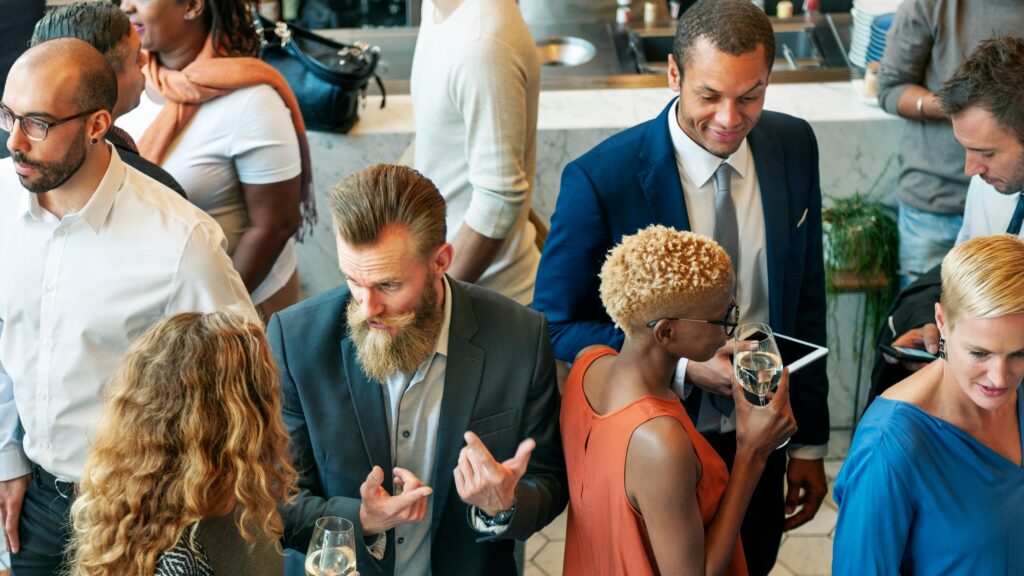
But alchemy never panned out. Alchemy was pseudoscience. So is the notion that collecting strangers in a physical location in Sweden will lead to natural exchange and ideas connecting. I have both experienced it myself and spoken to countless foreigners who live through the same thing. We do our best. We show up at the networking events, the mingles, the after works, the fikas and for one reason or another – sometimes there is an innocent explanation – we are lonely in a room full of people. The patrons may be diverse, but we are not all included. People show up with colleagues from their offices, form little circles of closed conversations with those they already know and ignore (or respectfully don’t disturb, depending on your point of view) everyone around them. Meaningful conversations between total strangers don’t just bubble up as a general rule.
The purpose here is not to lay blame at the feet of Swedish locals and wait for them to change. There is certainly plenty foreigners can do. Yet even model foreigners doing everything ‘right’ will run into the researched and documented reality that it’s hard to break into Swedish society. (Read this post for more help with that.) Building social trust in Sweden requires consistency, patience, determination, regular and repeated encounters over a sustained period of time. In short, it requires exactly the opposite of chance interactions at the cool hang out spaces where you bump into a new person and next week you’re besties because you found out you both had Labradoodles when you were children. (Go ahead and laugh, but this is a perfectly plausible situation where I come from.)
The question remaining is: After the science park designers have been so careful to create the physical spaces for interaction, how can we ensure that those conversations really arise? We can solve for the architectural space. (One easy, effective measure is to have large tables in dining areas. It’s too easy to have a small group of colleagues share a small table. Large tables force contact. Brilliant.) Can we solve for the human habit of sticking to our tribe and the cultural habit of not engaging in chit chat with people we don’t know? We must. But the solution can’t be to just ask people to be different.
Whatever solutions science parks implement, they must be pursued as collective actions – structural initiatives addressing the social, rather than the physical, structures. According to one expert discussing the Allen curve, we are four times more likely to communicate regularly with someone sitting two meters away from us as someone twenty meters away and we almost never communicate with colleagues on separate floors or in separate buildings. How about across campus in a completely different company and role? Forget it – unless the whole campus buys in and somehow motivates us to be in closer proximity to each other more regularly. That means devoting employees’ time to this mission.
A typical corporate response to that kind of idea may well be an eye roll and a more or less patient explanation that all of this sounds really good, but we are still a company and we need to make money. Those employees’ hours are expensive. And to that I answer, So what? AI has already shaken everything and we’ve probably only seen the beginning. If AI really can increase efficiency and productivity as touted, the responsible reaction is hardly to require your human resources to deliver the same increase in output, as if we are also machines. And if we don’t leave our employees some time to switch mental gears, they will run to keep up, but never gain. True inspiration strikes when the mind wanders. Thirdly, there is already a growing backlash against AI, life becoming ever more digital and the feeling that machine-level productivity is expected from human beings. (Check out this podcast for a great discussion on that.) Ignoring the human element of human resources is simply inhumane and your organization will pay the price.
Don’t be that employer. Be smarter. Schedule regular times, aligned with the whole ecosystem your company is embedded in, for your employees to engage in structured, spontaneous sociability. Why not a regular fika one week, planned lunch the next, after work the third week and rotating intentional cross-pollination visits the last? Simply describing a problem without offering solutions is a bad look, so let’s throw some spaghetti at the wall and see what sticks.
– do service projects together: organize cross-company groups by interest in project; it connects across organizations and to the community
– organize activities at an AW such as games and quizzes where a maximum of 2 players can already know each other and otherwise, they’re with strangers
– is there a school nearby? Invite the children over to see where (probably) many of their parents work and have them offer suggestions to some of the world’s most pressing problems
– turn things on their head for a fika or lunch and have the researchers and engineers serve the cleaning and catering staff
– host a career day for less science-centric functions. Open the park to communications companies, caterers, external training companies, legal offices and banks, but rather than them trying to market their services, have the park’s businesses try to sell themselves as customers. Why should I take them on as my client?
– have a science park-wide council with limited , rotating terms and which actually presents and report sto the community at some of the fikas or lunches.
– run a light-hearted incentive program; if an employee can provide specific enough facts to prove 3 new contacts at a mingle, they get a free refreshment (Bonus information: In addition to the curve named after him, Thomas Allen also identified the importance of information gatekeepers, colloquially known as natural networkers. These people organically connect disparate others and serve a vital, often underappreciated function. By tracking who wins the most sponsored refreshments, we can locate those people and make sure they have enough capacity in their schedules to engage in that important work.)
– organize mingles and fikas with games like people bingo (finding people who match the squares on your bingo card) or handing out puzzle pieces on entry. Find all five other people to complete your six-piece puzzle. To make sure you find something to talk about while searching for each other, there is a question written on the back of each pair of pieces.
– leave discussion questions as prompts at the large cafeteria tables. The questions should be more interesting than, “Where do you work” Something more like, “What science fiction or other fictional world would you most like to live in?”
– Create buddy systems partnering more senior and more junior personnel to attend events together. Further, having identified the information gatekeepers, support more junior personnel by having them shadow the master networkers now and then. Humans learn by doing.
What do you think? What kind of pressure do you face as a manager to get measurable results out of your employees, even if you know that they would be better served with a change of scenery now and then? Are you an employee who can’t bear the thought of another mingle and would rather hide in your lab? What solutions would work for you?

Comments are closed