

Have you ever heard complaints about how all Swedes dress alike, behave alike, don’t do anything outside the norm? Jantelagen! Don’t stick out. Sooner or later, it irritates most immigrants in some way. Coming from a very individualist country as I do, (What other nation would coin the expression “Let your freak flag fly”?) I can be honest that I, too, have taken note of the Swedish conformity.
Enter Saint Lucia.
Literally.
Lucia processions are difficult to avoid if you live in Sweden for at least one holiday season, but this past year one of my children was in the class responsible for their school’s procession. This child is not a joiner. He tells me with great self-awareness that he prefers to be unique, yet after all four Lucias had filed in, followed by all their handmaidens, star boys and elves, the gingerbread people – including my kid – tumbled in last.
And I felt some feelings, which surprised me. I’m not usually that kind of sentimental. I felt grateful, joyful, wistful and a little bit silly for feeling the first three. What on earth was going on?
To dissect this, we’ll use a tool colloquially called the Values Square, adapted by Friedemann Schulz von Thun. (The best information on that is all in German, like here. Here is a summary in English including examples in different contexts of life.) The idea with this tool is that two virtues in opposition to each other and out of balance can end in a terrible, escalating battle where no one wins. If these opposing virtues can find a healthy tension, they can bring out the best in each other and lead to something really productive. Here’s an example directly from Schulz von Thun.
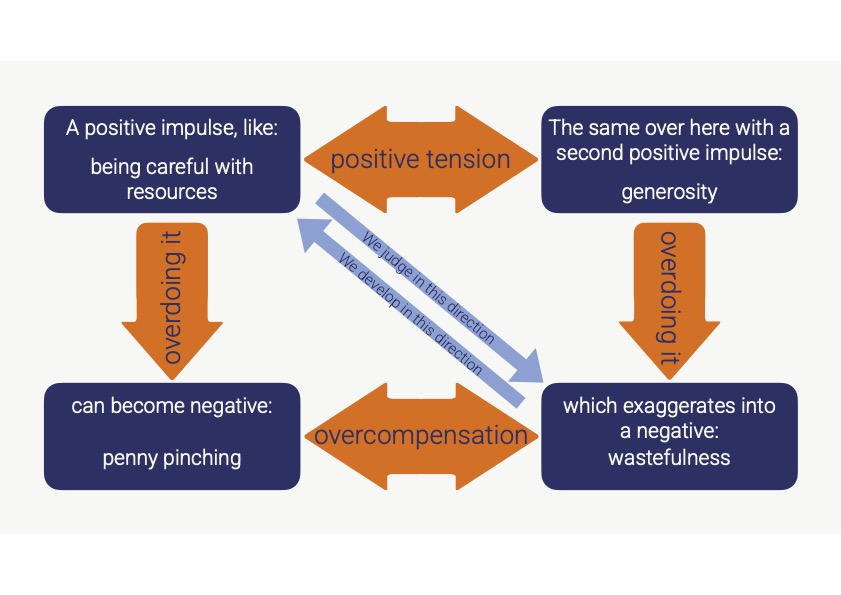
You can see how someone who handles their resources too carefully could end up becoming stingy and a very generous person could spend their resources wastefully. Typically, observing an opposite behavior makes humans judgmental (arrow diagonally down) and we react by increasing our own behavior. Faced with a careless spendthrift, the careful person counts their pennies once more before spending any. Faced with a selfish tightwad, the openhanded person shares more extravagantly. These are the downward arrows, “overdoing it”.
That can’t end well. We fall into a cycle of overcompensating for each other. But if we can recognize what is good in our opposite – both frugality and generosity are admirable and desirable at the right times, in the right amounts – then we can grow towards both (diagonal upward arrow) and aim for a positive tension with each other, keeping our worst impulses at bay and managing anything we encounter with intention.
Back to Lucia. All those tender sentiments arose from the juxtaposition of seeing my rootless, third-culture kid folded into the lap of Swedish tradition. The kids dressed up as expected (even my non-joiner), sang as expected, did everything conforming to the norm… except they didn’t. One Lucia was a little boy, another wore a hijab. All the elves had red hats on except the one in blue. One boy kept his hood up underneath his elf hat. All of the Lucias read a text except the one who let a handmaid read her text for her. The performance included both a violin solo and a boy rapping to a hip hop version of one of the classics.
The kids weren’t all the same. But they were all a part. And I began to understand the positive tension between being an individual and belonging to a whole. Let’s look at it graphically.
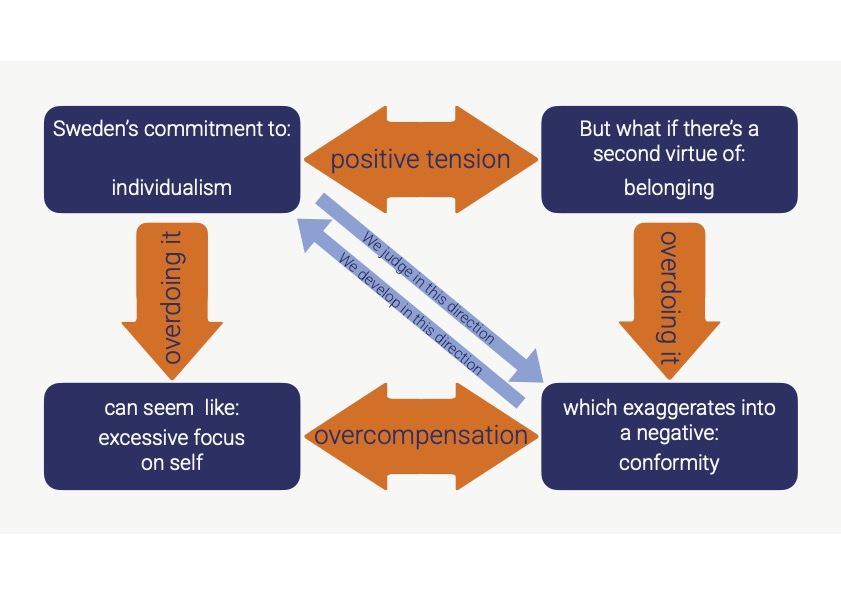
Given my cultural background, I feel quite strongly that being an individual, attending to the development of an individual and respecting individuals is a virtue. On the other hand, when we push this too far, it really can make an impression of selfishness, self-absorption, self-interest – you get the idea. Any word beginning with “self” will do. Do we even care about other people if the most important is always our self? For people entering Swedish society from a really different background, this might stick out a lot at first.
But then we also have that whole conformity problem. I recently queued behind six men, all tall, all blond or bald, five wore glasses, four of those were tortoiseshell frames, all six had brown dress shoes and some kind of non-jean, non-suit trouser and a blazer on. Talk about conformity! Pair that with my face blindness and I literally couldn’t tell them apart!
Most of us entering this country don’t fit the stereotype of a nordic divine being. We never will. But we still sense a pressure to somehow fit in, like we should do all the things and behave in all the ways, even if that is for whatever reason actually out of our reach. Why should non-Christian children be expected to celebrate a Christian holiday? Why should children who don’t enjoy dressing up be made to dress up? Isn’t that discriminatory?
This post can’t address all of that. The only point here is to give a new perspective on the conformity we perceive and the Lucia performance helped me there.
Children like mine lack the kind of cultural continuity they would get if they were raised in their parent’s home country, but I saw through Lucia that it can be achieved by, yes, conforming, to some degree, to what’s going on around us here in Sweden. The danger of too much individualism is not belonging to any larger group at all. Perhaps all those things Swedes do so faithfully, with such routine (Midsommar drinking songs, semlor, camel-colored trench coats), create the fabric of belonging.
Given how much individuality is allowed (if not always acted on), maybe these superficial rituals are the necessary signals that you both want to be and are part of the group. You might sing this song more traditionally, with less hip hop, but you sing this song. You might choose a blue hat instead of a red one, but you wear the hat. You might not want to perform all the parts of this role and let someone else read for you, but you are a part of what’s going on. You are a part. You belong.
I choose to look at the positive in both Swedish individualism and Swedish conformity, Pollyanna as I am. I aim to find my personal balance between the two, to hold them in tension and find the best, most useful outcome for myself. What will you do with it?


Comments are closed